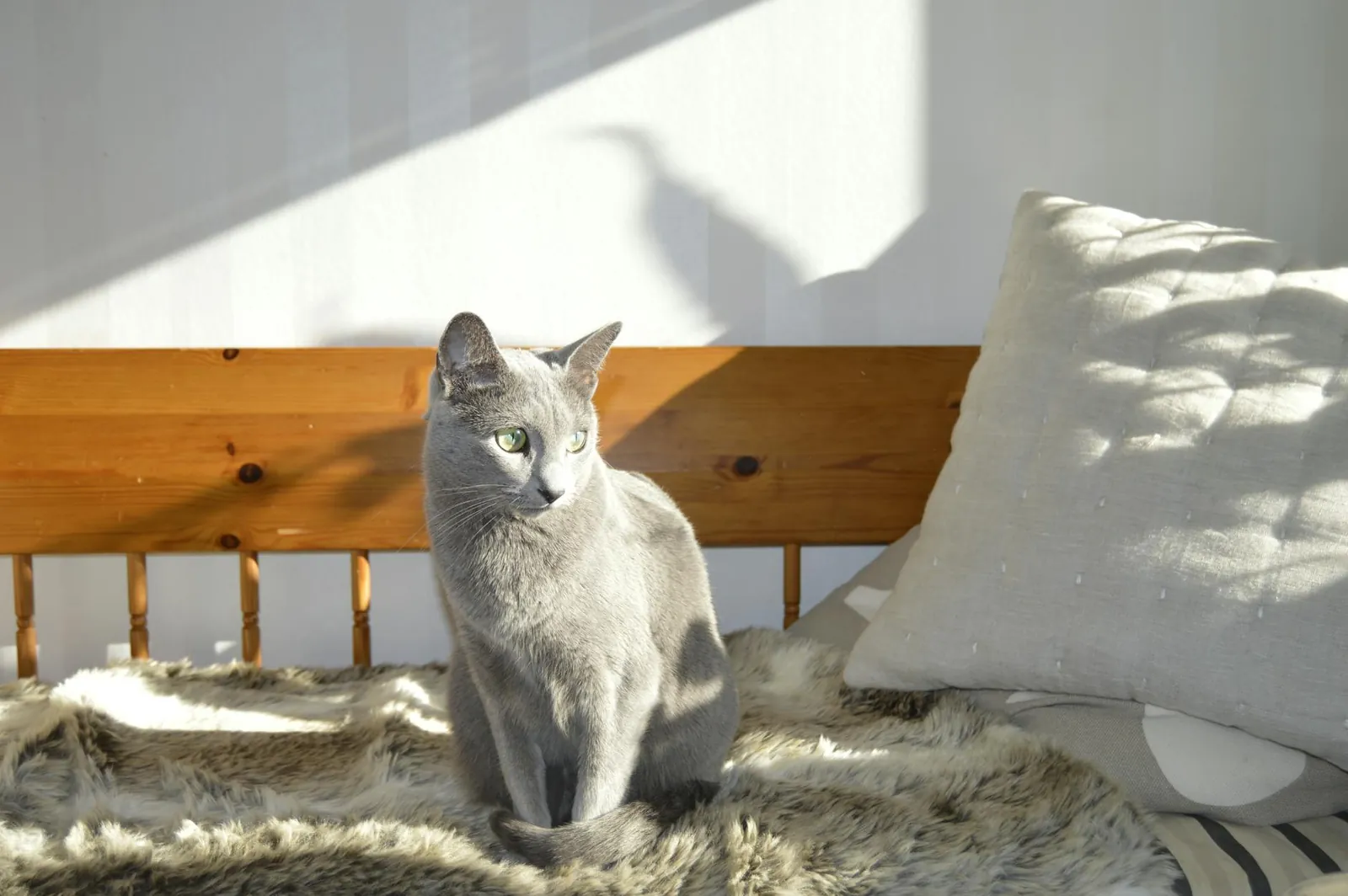
Russian Blue Cat: Breed Guide for UK Owners
The Russian Blue is a quiet, clean, short-coated cat that bonds closely with its own household and stays shy with strangers. It is a healthy breed with an easy coat, and it suits a calm home better than a busy one.
Prices and figures checked September 2026.
| Origin | Probably the Archangel area of northern Russia; shown in London from 1875 |
| Weight | About 3 to 5.5kg |
| Coat | Short, dense double coat with silver-tipped hairs |
| Eyes | Vivid green in adults |
| Temperament | Reserved with strangers, affectionate with its people |
| Grooming | A weekly brush |
| Kitten price | Most UK adverts £600 to £1,800, September 2026 |
| Registered by | GCCF (as the Russian, in blue, black and white), TICA, FIFe |
Are Russian Blue cats friendly?
Yes with their own people, but most are wary of strangers and will watch a visitor from a doorway before deciding whether to come over.
The GCCF describes the breed as reserved at first and "extremely affectionate" once it has sized people up. In practice a Russian Blue tends to follow its owner from room to room, wait at the door and sleep on the bed, without demanding a lap. Many hide when guests arrive and come out when the house is quiet again. They also notice change: a house move, a new partner or a new pet can put one off its food for a while.
Are Russian Blue cats good with kids?
They usually do well with calm older children who let the cat come to them, and less well with toddlers or a loud, busy household.
A Russian Blue avoids trouble rather than lashing out, so a noisy home tends to produce a cat that spends its day under the bed. Give it high shelves and a quiet room it can retreat to. Most accept a calm, cat-friendly dog if introduced slowly.
Are Russian Blue cats hypoallergenic?
No. Russian Blues are often advertised as allergy-friendly, but there is no good evidence that the breed produces less of the Fel d 1 allergen than other cats.
Allergen levels vary more between individual cats than between breeds. If someone in the house is allergic, spend time with adult Russian Blues, on more than one visit, before committing to a kitten. Returning a cat months later is hard on everyone.
Do Russian Blue cats shed?
A little: the dense double coat sheds lightly for most of the year and more in the spring moult, and a weekly brush keeps it under control.
A rubber grooming mitt or soft slicker brush works well; brush twice a week during the moult. The coat rarely mats or picks up dirt, and bathing is almost never needed. The cat brush guide covers tools for short coats.
Do Russian Blue cats have blue eyes?
No. Adult Russian Blues have vivid green eyes; the "blue" is the coat colour. Like all kittens they are born with blue eyes, which pass through yellowish before turning green over the first months.
An adult with copper or orange eyes is more likely a Chartreux or a blue British Shorthair, and a long-haired cat of this type is a Nebelung. If a seller calls a kitten "Russian Blue type", it is not a registered Russian Blue.
How long do Russian Blue cats live?
Many live into their mid to late teens, although a 2024 UK study of cats under vet care put the Russian's life expectancy at birth at about 10 years.
That VetCompass figure rests on only 19 recorded deaths and includes cats that died young, so it is a rough guide. The GCCF describes the breed as generally very healthy, with no major genetic problems reported. The commonest problem is weight gain: Russian Blues are keen eaters, and the thick coat hides a spreading waistline, so feed measured meals and weigh the cat every few months.
Are Russian Blue cats indoor cats?
They can live happily indoors, and many breeders prefer it, though a Russian Blue can also have safe outdoor access like any other cat.
A shy cat that bolts from noise is not ideal next to a busy road, and an expensive-looking pedigree may be taken. An indoor Russian Blue needs daily play, somewhere high to sit and a window to watch from. The indoor vs outdoor cats guide weighs up both.
What a Russian Blue costs in the UK
Most Russian Blue kittens advertised on Pets4Homes on 28 September 2026 were priced between about £600 and £1,800, with a median of about £1,250. Good breeders often have waiting lists. A much cheaper "pedigree" grey kitten without papers is usually a moggy or a cross.
See the kitten with its mother, check the GCCF or TICA registration, and expect kittens to stay with the breeder until 12 to 13 weeks. In England, kittens must be bought directly from the breeder or a rescue, not a third-party seller (gov.uk guidance). Adults occasionally come up for rehoming through breed clubs and general rescues; see adopting a rescue cat. For running costs, see how much a cat costs in the UK.