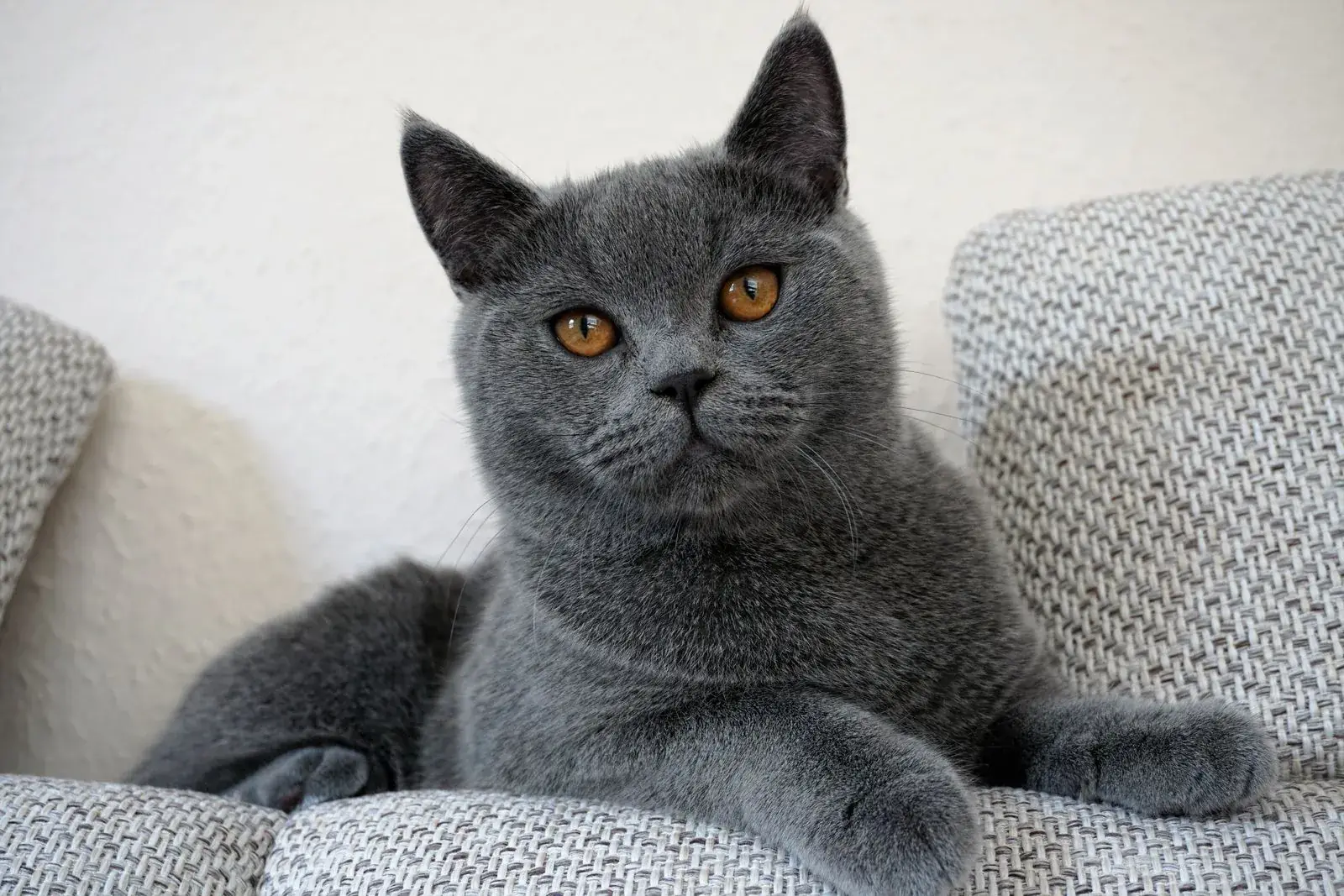
British Shorthair cat with round face and dense blue-grey coat sitting on grass

This article contains affiliate links. We earn a small commission if you buy through our links, at no extra cost to you. We only recommend products we'd actually use.

British Shorthair: Complete Breed Guide for UK Owners

At a Glance

OriginUnited Kingdom
Average Weight4-8 kg (males typically 5.5-8 kg, females 4-5.5 kg)
Lifespan12-20 years
TemperamentCalm, independent, loyal, quietly stubborn
Average Cost (UK)GBP 1,200-2,500 (GCCF registered breeder)
Good ForApartments, families, first-time owners, working professionals
Grooming LevelLow to moderate (weekly brush)
Activity LevelLow to moderate - not lazy, just dignified

Overview

The British Shorthair is the most popular pedigree cat breed in the UK, and it is not hard to see why. They are solidly built, easy-going, and gorgeous to look at. The classic blue (grey) coat is the one most people picture, but BSH cats come in over a hundred colour and pattern combinations. Think of them as the Labrador of the cat world, but with considerably more attitude and zero interest in fetching anything for you.

Their popularity in the UK has exploded over the last decade, partly thanks to social media and partly because they genuinely suit modern living. They do not demand constant attention. They are not climbing your curtains at 3am. They are content to sit near you rather than on you, which makes them ideal for people who want a companion cat without the full-time commitment of a Bengal or Siamese. That calm temperament comes at a price, though, and we do not just mean the GBP 1,500 you will hand to a breeder.

Before you fall in love with those round copper eyes and that plush coat, there are some things you need to know. British Shorthairs are prone to specific health conditions that can get expensive. They gain weight like it is their full-time job. And despite what Instagram suggests, most of them have absolutely no interest in sitting on your lap. This guide covers all of it honestly, because you deserve better than another breed profile that reads like a sales brochure.

Temperament and Personality

British Shorthairs are often described as "easy-going" and "laid-back," which is accurate but also the polished version. Here is the unpolished version: they are friendly on their own terms, and those terms are non-negotiable.

A BSH will follow you from room to room. They will sit beside you on the sofa. They might even tolerate being picked up briefly. But they are not lap cats in the way most people imagine. Many BSH owners spend the first six months wondering why their cat will sit three inches away from them but refuses to sit on them. That is not a defect. That is the breed. They show affection by proximity, not by climbing on you.

They are also quietly stubborn. If a British Shorthair decides that a particular spot on the kitchen counter is their spot, no amount of spray bottles or aluminium foil is going to change their mind permanently. They will wait you out. They have the patience and the temperament for it.

The genuine upsides are significant, though. They are tolerant of children, generally unbothered by dogs, and cope well with being left alone during working hours. They are not destructive out of boredom (usually), and they rarely develop the neurotic behaviours you see in more high-strung breeds. They are also unusually quiet. If you have lived with a Siamese, a British Shorthair will feel like switching from a heavy metal concert to a library. If you want a similarly calm but more affectionate breed that actively seeks lap time, have a look at our Ragdoll breed guide.

British Shorthairs mature slowly. They do not reach full physical and behavioural maturity until around 3-5 years old. That chubby kitten energy will calm down, but it takes longer than most breeds.

One thing that catches people off guard: BSH cats can be one-person cats. They will be polite to everyone in the household, but they often pick a favourite human and reserve their real affection for that person. If you live alone, great. If you are buying a "family cat" and expecting equal distribution of love, manage those expectations.

Health Issues to Know About

British Shorthairs are generally robust cats, but "generally robust" does not mean "never needs a vet." The breed has some specific health vulnerabilities you should know about before buying, because pretending they do not exist helps nobody.

Hypertrophic Cardiomyopathy (HCM)

This is the big one. HCM causes the heart muscle to thicken, reducing its ability to pump blood efficiently. It is the most common heart disease in cats generally, but British Shorthairs are genetically predisposed to it. A reputable breeder will screen their breeding cats via echocardiogram. If a breeder tells you "the breed doesn't get HCM" or refuses to show you screening results, walk away.

Estimated cost: Echocardiogram screening is GBP 200-400. If your cat develops HCM, ongoing medication runs GBP 30-60 per month, with regular monitoring appointments at GBP 150-300 each. Lifetime management of a diagnosed cat can run into thousands.

Polycystic Kidney Disease (PKD)

PKD causes cysts to form in the kidneys, eventually leading to kidney failure. It is inherited, and a simple DNA test can identify carriers. Again, responsible breeders test for this. Ask for proof.

Estimated cost: DNA screening is GBP 50-100. Treatment for kidney disease (special diet, medications, fluid therapy) can cost GBP 100-300 per month in advanced stages.

Obesity

This is not a genetic disease, but it might as well be listed as one for British Shorthairs. They are stocky, solid cats with a naturally low activity level and an enthusiasm for food that borders on obsessive. An overweight BSH is not "chunky" or "cuddly" - it is a cat heading for joint problems, diabetes, and a shorter life. This is the health issue you have the most control over, and the one most owners get wrong.

Estimated cost: Prescription weight management food runs GBP 30-50 per month. Diabetes management, if it gets that far, costs GBP 80-150 per month for insulin and monitoring.

Joint Issues

Related to their weight, British Shorthairs can develop arthritis and joint problems, particularly in middle age and beyond. Their heavy, cobby build puts extra stress on joints, especially if they are carrying excess weight.

Never buy a British Shorthair kitten without seeing HCM and PKD screening results for both parents. Any breeder who cannot or will not provide these is not worth your money or your heartbreak.

What Your Insurance Should Cover

Get lifetime cover, not time-limited or maximum benefit policies. HCM and kidney disease are chronic conditions. A policy that caps out after 12 months or at GBP 4,000 will leave you exposed exactly when costs escalate. Expect to pay GBP 15-30 per month for decent lifetime cover on a BSH from a provider like Petplan, Bought By Many (now ManyPets), or Agria.

Best Food for British Shorthairs

Feeding a British Shorthair is straightforward in principle and challenging in practice, because the principle is "high protein, controlled portions" and the practice is a cat staring at you like it has not eaten in six days when its last meal was two hours ago.

BSH cats need a high-protein, moderate-fat diet with careful portion control. Their tendency to gain weight means free-feeding (leaving food out all day) is a terrible idea. Measured meals, twice a day, weighed on a kitchen scale. Yes, really. Eyeballing portions is how British Shorthairs become spherical.

What to Look For

Brands Worth Considering

Lily's Kitchen - Widely available in UK supermarkets and pet shops. Their grain-free recipes have 65% meat content, which is solid. Not the cheapest option at roughly GBP 40-50 per month for wet food, but the ingredient quality is genuinely good. Available at most Sainsbury's and Pets at Home. [AFFILIATE: Lily's Kitchen]

Scrumbles - A UK brand that does not get enough attention. High meat content, added prebiotics for gut health, and competitively priced. Their dry food is around GBP 12-15 for 750g. Good option if your BSH prefers kibble, though we would always recommend a mix of wet and dry. [AFFILIATE: Scrumbles]

Encore - If you are after a complementary wet food with extremely high meat content (75%+), Encore is hard to beat on value. Around GBP 0.80-1.00 per tin. Be aware that most Encore products are complementary, not complete, so you will need to pair them with a nutritionally complete dry food. [AFFILIATE: Encore]

Weigh your cat monthly and keep a record. British Shorthairs should feel solid but not round. You should be able to feel their ribs without pressing hard. If you cannot, cut back portions by 10% and reassess in a fortnight.

Grooming and Care

British Shorthairs have a dense, plush double coat that is surprisingly low-maintenance for how luxurious it looks. A weekly brush is enough for most of the year, increasing to two or three times a week during spring and autumn shedding seasons.

Coat Care

Use a slicker brush or a rubber grooming mitt rather than a fine-toothed comb. The dense undercoat responds better to tools that can get through it without dragging. A KONG ZoomGroom (around GBP 6-8) is genuinely one of the best tools for BSH coats, and most cats actually enjoy the rubber massage feeling. [AFFILIATE: KONG ZoomGroom]

Bathing is almost never necessary. British Shorthairs keep themselves clean, and their coat's natural oils give it that distinctive plush texture. If you bathe them frequently, you strip those oils and the coat loses its character.

Dental Care

Like all cats, BSH cats are prone to dental disease if teeth are not maintained. Dental treats, a water additive, or (if your cat tolerates it) brushing with a cat-specific toothpaste all help. Professional dental cleaning at the vet costs GBP 200-400 under general anaesthetic, so prevention is worth the daily effort.

Nail Trimming

Every 2-3 weeks, check and trim if needed. Indoor BSH cats will need more frequent trimming than those with outdoor access. A decent pair of cat nail clippers costs under GBP 5 and lasts years.

Exercise and Enrichment

British Shorthairs are not hyperactive, but calling them lazy is unfair and also unhelpful. They need stimulation. Without it, they eat more, sleep more, and gain weight - which then makes them less active, which makes them gain more weight. It is a cycle you need to break proactively.

What Actually Works

Interactive play sessions: Two 10-15 minute sessions per day with a wand toy. BSH cats respond well to toys that mimic ground-level prey (mice, bugs) rather than airborne targets. A Da Bird wand with the ground attachment is excellent. [AFFILIATE: Da Bird]

Puzzle feeders: Scatter feeding or using a puzzle feeder for dry food portions makes them work for their calories. This is particularly important for BSH cats because it slows down eating and provides mental stimulation. The Catit Senses Food Tree (around GBP 10-15) is a good starter. [AFFILIATE: Catit Senses Food Tree]

Cat trees and perches: They are not great climbers compared to breeds like the Abyssinian, but they do enjoy having elevated vantage points. A sturdy, mid-height cat tree (avoid the ceiling-height ones unless your BSH is unusually athletic) with a wide platform that can take their weight is ideal. Look for platforms at least 35 cm wide, because a standard-sized platform is too narrow for a fully grown male BSH. Check prices on Amazon

Scratching posts: Provide at least two, in different styles (one vertical, one horizontal). Sisal rope is more durable than carpet-covered posts. Place one near their favourite sleeping spot, because cats like to stretch and scratch when they wake up. If you do not provide good scratching options, they will find their own, and your sofa will be the casualty.

Rotate toys every few days. British Shorthairs get bored with the same toy left out permanently. Put half away and swap them weekly - suddenly "old" toys become interesting again.

Cost of Owning a British Shorthair in the UK

Let's talk money, because the purchase price is just the entrance fee. Here is what a British Shorthair actually costs to own, broken down honestly.

Purchase Price

SourceTypical CostNotes
GCCF registered breederGBP 1,200-2,500Health-tested parents, vaccinated, microchipped, 13+ weeks old
Unregistered breederGBP 500-1,000No guarantees on health screening. Higher risk. Lower price reflects that risk, not a bargain.
Breed-specific rescueGBP 75-150Adoption fee covers neutering and vaccinations. Older cats more commonly available.
"Rare colour" premiumGBP 2,500-4,000+Lilac, cinnamon, golden shaded. The premium is for fashion, not health or temperament.

Annual Running Costs

ExpenseAnnual CostNotes
Food (quality wet + dry)GBP 400-700Depends on brand. Premium food is GBP 50-60/month.
Pet insurance (lifetime)GBP 180-360GBP 15-30/month. Do not skip this on a breed prone to HCM.
Annual vet check + vaccinationsGBP 80-150Boosters, health check, flea/worm treatment.
LitterGBP 120-250GBP 10-20/month depending on litter type.
Flea and worm treatmentGBP 60-120Monthly spot-on or 3-monthly tablets.
Toys, scratching posts, replacementsGBP 50-100Less than you think, if you buy decent quality upfront.
Cattery / pet sitter (2 weeks)GBP 150-350GBP 10-25/day depending on location and season.
Total annual costGBP 1,040-2,030

First-Year Setup Costs

On top of the purchase price, budget GBP 200-400 for initial setup: litter tray, food bowls, carrier, scratching post, bed, initial toys, and microchip registration if not already done. Some breeders include a starter pack, but do not count on it.

If someone is selling "GCCF registered British Shorthair kittens" for under GBP 800, something is wrong. Either they are not GCCF registered, the parents have not been health-tested, or both. Cheap kittens often mean expensive vet bills.

Is a British Shorthair Right for You?

Yes, if...

No, if...

Where to Get a British Shorthair in the UK

GCCF Registered Breeders

The Governing Council of the Cat Fancy (GCCF) is the UK's primary cat registration body. Their breeder list is the best starting point: gccfcats.org. You can also check TICA (The International Cat Association) registered breeders, though GCCF is more widely used in the UK.

Expect to join a waiting list. Good breeders do not have kittens available immediately, because they are not running a kitten factory. A 3-6 month wait is normal and actually a good sign.

Breed-Specific Rescues

If you are open to an adult cat (and you should be - adult BSH cats are wonderful), check these organisations:

Red Flags When Buying

Walk away from any breeder who:

Ask to see the breeder's GCCF prefix number. Every registered breeder has one, and you can verify it directly with the GCCF. If they hesitate, that tells you everything you need to know.

Related Guides

Other Breed Guides

Helpful Articles

Explore more on CatBasket