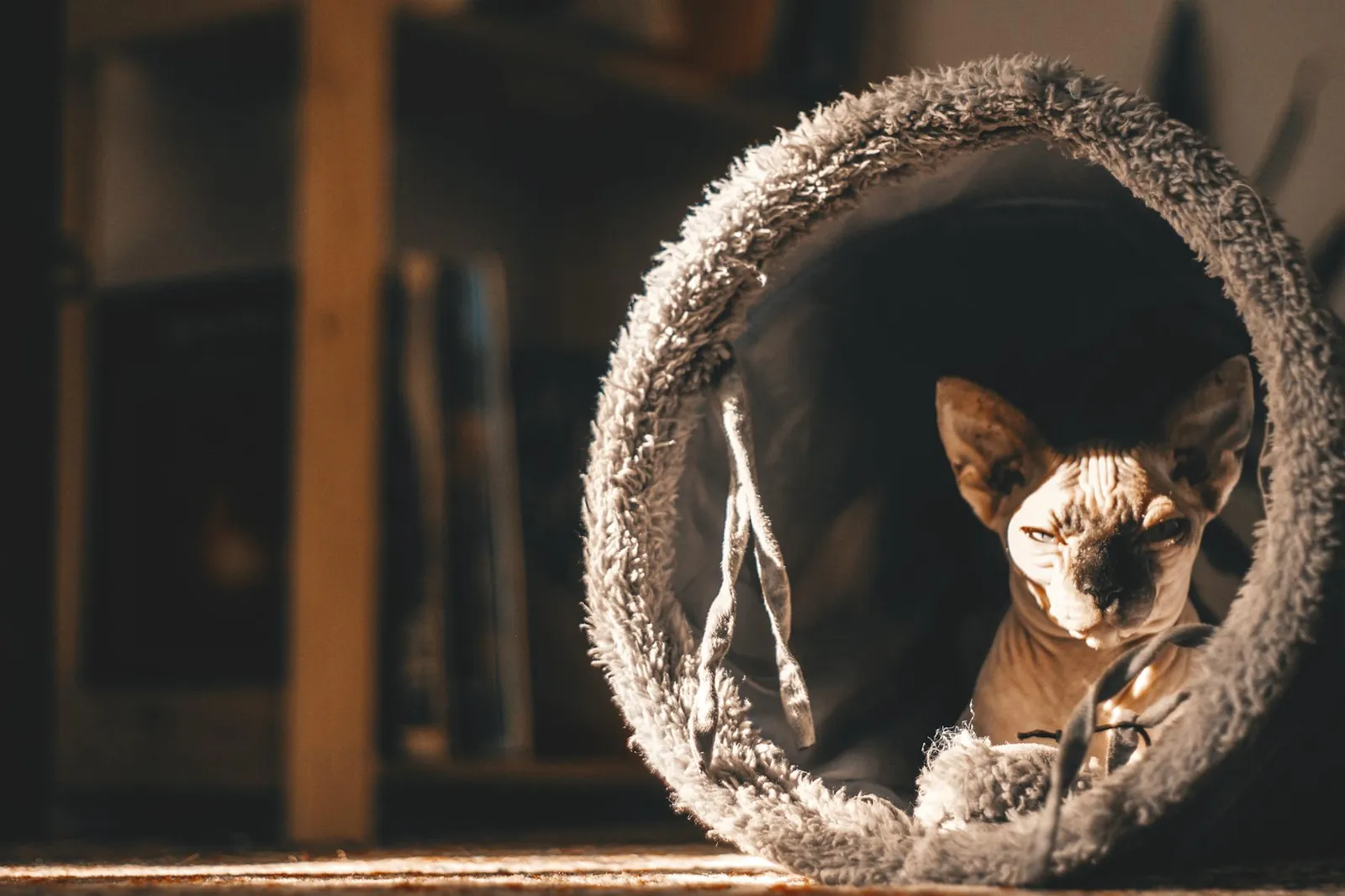
Sphynx Cat: Breed Guide for UK Owners
The Sphynx is an affectionate, attention-hungry hairless cat that needs regular baths, sun protection and an indoor life. It is not hypoallergenic, and it is prone to an inherited heart disease, so buy only from a breeder who heart-scans both parents.
Prices and figures checked September 2026.
| Origin | A hairless kitten called Prune, born in Ontario, Canada, in 1966 |
| Weight | About 3 to 5.5kg |
| Coat | A fine down, almost invisible |
| Temperament | Very sociable, clingy, playful |
| Care | Regular baths, ear and claw cleaning, sun protection |
| Main health risk | Hypertrophic cardiomyopathy (HCM) |
| Kitten price | Most UK adverts £450 to £1,000, September 2026 |
| Registered by | GCCF, TICA, FIFe |
Are Sphynx cats hypoallergenic?
No. Sphynx cats produce the Fel d 1 allergen in their saliva and skin oils like any other cat, and having no coat does not stop an allergic reaction.
Breeders who advertise "hypoallergenic" Sphynx kittens are selling a myth. If someone in the house is allergic, spend time with adult Sphynx cats before committing, and ask your GP about allergy testing.
Are Sphynx cats natural?
Yes, the hairlessness began as a natural mutation: the first recorded Sphynx kitten, Prune, was born to an ordinary black and white cat in Ontario in 1966.
Breeders then built the breed from that and later hairless kittens. The Animal Welfare Committee notes that the Sphynx is one of several breeds founded from a single cat with the desired trait, which leaves a small gene pool. Most Sphynx are not completely bare. The GCCF describes a soft down that is almost impossible to see or feel.
Do Sphynx cats need baths?
Yes. With no fur to absorb it, skin oil builds up on a Sphynx, so most need a bath with a gentle cat shampoo every week or two.
Without baths the skin gets greasy, marks furniture and can develop blackheads and yeast infections, and the cat starts to smell. Dry the cat thoroughly and keep it warm afterwards. The oily build-up also collects in the ears and around the claws, which need cleaning with the bath. Start baths young so the cat accepts them.
Do Sphynx cats get cold?
They feel the cold more than a coated cat and seek out warm spots, but a normally heated home is enough and overheating them makes them sweat.
The Animal Welfare Committee says hairless cats may struggle to keep comfortable in cold temperatures. The GCCF adds that they do not need extra heat, which only makes them sweat more. So give it warm, draught-free beds, a blanket or a self-warming pad, and a warm window spot, shaded in summer. Many owners use a cat jumper in a cold house. See the cat bed guide for warm beds.
Do Sphynx cats need sunscreen?
They need protecting from the sun, because bare skin burns easily; the GCCF describes the Sphynx as an indoor cat for that reason.
Keep the cat indoors or in a shaded, secure outdoor run, and block strong sun at south-facing windows in summer. Do not use human sunscreen, as some ingredients are harmful to cats if licked; ask your vet for a pet-safe product if the cat will be in the sun. The indoor vs outdoor cats guide covers safe outdoor space.
Are Sphynx cats healthy?
They have serious health risks: hypertrophic cardiomyopathy (HCM) is the main one, and a 2024 UK study found the shortest life expectancy of any breed it analysed.
- HCM thickens the heart muscle and can cause heart failure or sudden death. The GCCF says it affects young to middle-aged Sphynx cats. Researchers have linked a gene variant, ALMS1, to HCM in the breed, and breeders screen with heart scans (echocardiograms). Ask to see recent scan results for both parents.
- Hereditary myopathy, an inherited muscle disease, occurs in Sphynx and Devon Rex cats. The Animal Welfare Committee lists it, and there is a DNA test.
- Skin problems, including yeast and bacterial infections, are more common without a coat, and the bare skin is easier to injure.
In the Royal Veterinary College's 2024 VetCompass study, a Sphynx's life expectancy at birth was about 6.7 years, against about 12 for all cats. That figure rests on only 18 deaths and the GCCF says Sphynx can live 15 years or more, but it is a reason to choose a breeder carefully and insure early (is cat insurance worth it?).
Do Sphynx cats have whiskers?
Many have none, or only short, broken or curly ones, and most also lack eyebrows, which the Animal Welfare Committee notes as part of the breed.
Are Sphynx cats friendly?
Yes, extremely: the GCCF calls the Sphynx possibly one of the most affectionate and sociable cats in the world,.
A Sphynx wants to be on your lap, under the duvet and involved in whatever you are doing. That makes it a poor fit for a house that is empty all day. If you work away from home, a second cat helps. Most Sphynx get on with other cats and calm dogs. The Devon Rex has a similar personality with a coat.
What a Sphynx costs in the UK
Most Sphynx kittens advertised on Pets4Homes on 28 September 2026 were priced between about £450 and £1,000, with a median of about £800 and a few asking £1,300 to £2,500. Kittens from registered breeders who heart-scan their cats can cost more. Beyond the kitten, budget for shampoo, warm bedding and higher pet insurance, and see how much a cat costs in the UK.
Visit the kitten with its mother, check the registration, ask for the parents' heart scan results, and expect kittens to stay with the breeder until at least 12 to 13 weeks. In England, kittens must be bought directly from the breeder or a rescue (gov.uk guidance). Walk away from anyone selling a "hypoallergenic" Sphynx or a kitten at eight weeks.